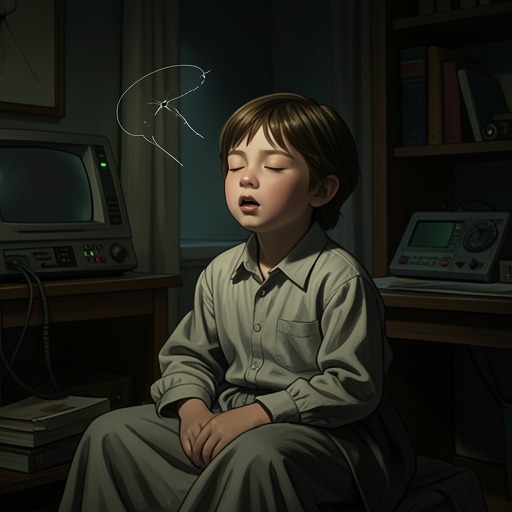
White Chocolate
The Character of RainWhite Chocolate is the small gift that transforms the Narrator (God) from a child treated as inert into a person who experiences pleasure, claims an identity, and begins to remember. Given by Grandmother when the child is two and a half, it does more than introduce a new taste: in the narrator’s account, its sweetness brings a first-person self into being. The stick’s brief presence thus becomes the starting point for a lifelong chain linking bodily sensation, consciousness, memory, and the obligation to remember the giver.
Before the Gift
Before the awakening, the child has been called the Tube and then the Plant. Specialists test the child’s reflexes and pupils without finding a response, and the parents describe a child who neither cries nor moves nor makes a sound. The specialists diagnose pathological apathy and advise hospitalization. The parents decline: they already have two children they regard as fully human, and they find it bearable to have a third whom the doctors describe as a vegetable. They even develop tender feelings for the child. Their affectionate name, the Plant, expresses care, but it also reflects their inability to imagine an inner life behind the child’s stillness.
The narrator later places this condition within a broader challenge to the assumption that development must proceed along a fixed path. By the age of two, the child has not tried to crawl or made a peep; the adults around the child assume that development is physically blocked. The retrospective account instead entertains the possibility that the absence of movement and speech cannot be explained solely as bodily failure. This distinction matters to the story of White Chocolate: the gift does not arrive as a treatment prescribed by specialists, but as an unexpected experience that alters what the child can feel and do.
The Gift and Awakening
In February 1970, in Shukugawa, Kansai, Japan, Grandmother approaches the child with a white stick. The Narrator (God) has not seen such an object before. Grandmother identifies it as white chocolate from Belgium and explains that it is for eating. The child recognizes the word for eating but has no prior category for chocolate or Belgium. The object is therefore at once partly intelligible and wholly unfamiliar: its whiteness connects it to known things, while its name and taste belong to an unknown world.
The child responds with both hesitation and desire. Rather than needing to bite through it, the child finds that the substance melts on the tongue. The ensuing sweetness, as the narrator remembers it, forces out a voice that recognizes itself as a self rather than an impersonal thing. The change is immediate in the account: sensation becomes language, and language makes possible the distinction between an object and the person experiencing it. The chocolate does not merely provide pleasure to an already formed self; the narrator presents pleasure as the means by which the self first becomes perceptible to itself.
The awakening is also visible to the family. The child is passed from arm to arm, while Mother and Father react with astonishment, delight, and irritation, and ask Grandmother how she brought about the transformation. Grandmother does not disclose the chocolate, keeping the cause of the change secret. The parents wonder whether she performed an exorcism, but the narrator says that the child understood what had happened. Mother, who believes sugar responsible for many of the world’s ills, has unknowingly had her view confounded: the substance she regards as poison has helped make her third child socially responsive. After two years regarded as a vegetable and a further period regarded as a wild creature, the child seems more or less normal to the relieved parents, who begin using the child’s first name.
Pleasure, Identity, and Memory
The narrator treats pleasure as the principle that joins sensation to identity. Each mouthful confirms the self’s relation to what it enjoys: pleasure is not an addition to an otherwise complete person but the experience through which the person can say, in effect, that there is a self here. The sweetness also complicates any simple opposition between bodily enjoyment and intelligence. In the narrator’s argument, pleasure awakens thought and makes existence worth inhabiting; self-denial, by contrast, risks turning into a celebration of deprivation. White Chocolate is therefore both a physical object and the occasion for a theory of consciousness grounded in the body.
The object’s importance extends beyond the moment of eating because the narrator connects the new identity to the birth of memory. The narrator claims to remember everything after February 1970, while qualifying that claim: not every parental worry or conversation remains in memory, but certain experiences—the lake where the child learned to swim, the garden, and plum wine tasted without permission—do. Before the chocolate, the narrator remembers nothing firsthand and must depend on what others report; afterward, the narrator distinguishes remembered experience from inherited recollection. The account also acknowledges that the sweeping claim cannot be proved or disproved, and that the narrator is increasingly indifferent to being believed. White Chocolate thus marks not just the beginning of remembered life but the boundary around what the narrator can claim to know directly.
Loss and Return
Later, after Grandmother’s death, the narrator sits on the stairs thinking about her and the white chocolate. The gift becomes part of an imagined exchange: Grandmother helped free the child from death, and the narrator wonders whether her own death was somehow the price. This is the narrator’s interpretation, not an established explanation of the events. What can be returned, the narrator decides, is memory. By keeping Grandmother alive in recollection—still bearing her bar of white chocolate like a queen carrying a scepter—the narrator answers the gift with a continuing act of remembrance.
That return gives the object a second life. The chocolate itself was consumed, but its consequences persist as identity, pleasure, and memory; the remembered image of Grandmother holding it preserves both giver and gift. The narrator’s account is candid about the limits of recollection elsewhere, and later even entertains the possibility that some remembered experiences were dreamed or made up. Yet the scar on the narrator’s left temple serves as material corroboration for a different memory, illustrating the narrative’s recurring negotiation between remembered experience and evidence. White Chocolate remains the story’s originating gift: a fleeting object whose lasting return is not physical, but the self and memory that the narrator says it made possible.